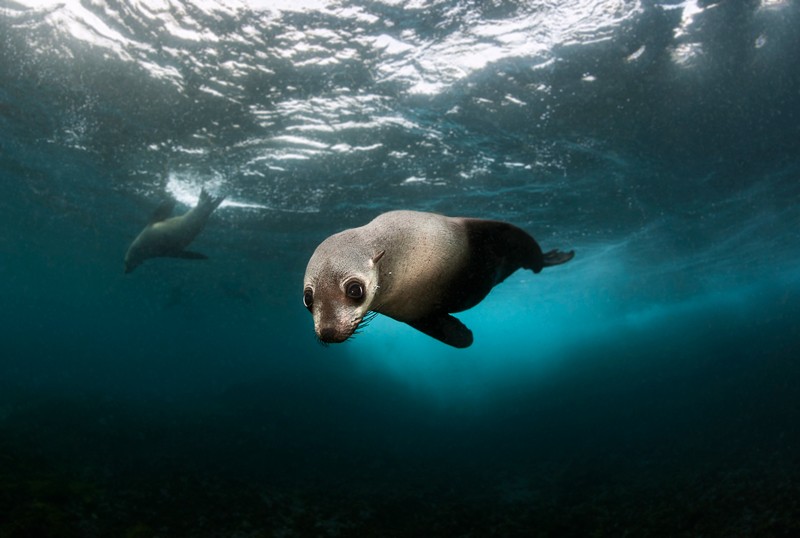
Australian Fur Seals are listed as vulnerable in New South Wales (under the Biodiversity Conservation Act 2016). They are fully protected in Australia, although their numbers are probably still only half those of the historic pre seal hunting days.
Where Do They Live?
They frequent coastal waters and beaches along eastern Australia. Pregnant females come ashore just prior to giving birth, typically to a single pup, between October and December.
Each year, Australian Fur Seals leave the ocean behind and come ashore to form breeding colonies at key sites. The adult males are the first to arrive, staking out territories along the open rocky and flat shoreline. Once the females gather within these areas, the resident males defend their space fiercely.
What Do They Eat?
Australian Fur Seals are talented hunters and feed on a variety of bony fish, squid and octopus. Opportunistic by nature, they often take advantage of situations where fish are trapped by nets or gathered around fish farms.
What Do They Look Like?
The Australian Fur Seal is the largest seal found in Australian waters, reaching lengths of up to 230cm. Their fur coat is thick and dark grey-brown and covers everywhere except their flippers.
Like many animals, their look can change depending on how clean they are and how long it’s been since their last moult - sometimes sleek and shiny, other times a little scruffy. The seal’s head is distinctly triangular and pointed with whiskers.
These seals have a streamlined shape and strong flippers, making it an agile swimmer that can dive to depths of 200m to catch fish and squids. Fur seals also differ from other seals because they have external ears and the ability to use all four limbs to move across land.
The species is sexually dimorphic, meaning that the males and females are visibly different. The males are larger with a larger dark mane of coarse fur. Males typically weigh 220-360kg while the females weigh 40-113kg.
How Can You Support The Australian Fur Seal?
- Report any sightings of seals in distress to ORCCA via their website or on 02 9415 3333.
- Keep your distance: If you see a seal on the beach keep a respectful distance and restrain your dog. If you see a seal in the water do not approach them and maintain a distance of 30m.
- Dispose of any fishing line or fishing gear appropriately: Seals can get entangled in fishing gear and marine debris.
- Slow down and keep an eye out when boating: This will also help conserve other species such as little penguins.
- Manage household chemicals: Use minimal amounts of fertilisers and pesticides on lawns and wash cars with water or eco-friendly soap to prevent chemicals from washing into our local waterways.
- Join local clean ups: Participate in local clean up groups such as the Northern Beaches Clean Up Crew.
Fun Facts
- Australian Fur Seals have two layers of fur, while most other seals only have one.
- They have a set of carnivore-like teeth similar to dogs.